Using rapid design iteration and virtual testing to develop motorcycles faster
Ducati uses Siemens Xcelerator for instant performance analysis to optimize race-day adjustments

Ducati
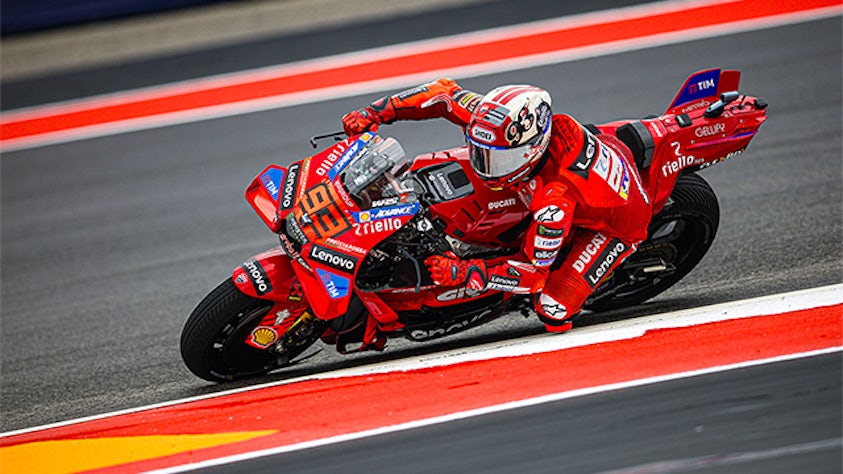
Ducati Corse, Ducati Motor Holding S.p.A.’s racing division, employs about 100 specialists and has been a driving force in motorcycle racing innovation for over two decades. In 2023 and 2024, Ducati achieved 22 victories in 23 MotoGP races. It has secured six Constructors championships, including five straight.
https://www.ducati.com/us/en/home
- 總部:
- Borgo Panigale, Bologna,, Italy
- 產品:
- Mendix
- 產業領域:
- Automotive & transportation
Thanks to NX CAD, we can rapidly develop and test new designs, reducing errors and optimizing aerodynamics.
Engineering for victory
Founded in 1926 in Borgo Panigale, Bologna, Italy, Ducati Motor Holding S.p.A. initially specialized in radio components. After World War II, the company shifted its focus to engines and small motorbikes, laying the foundation for what would become one of the most iconic motorcycle brands in the world. Although Ducati Corse, the company’s dedicated racing division, was formally established in 1999, racing has always been a key part of Ducati’s development strategy, as trackside testing is critical to innovation and performance optimization.
Ducati Corse has been synonymous with high-performance motorcycle racing worldwide for over two decades. Competing at the highest levels, including MotoGP, Ducati constantly pushes the limits of technology to stay ahead of the competition. With approximately 100 specialists working at Ducati Corse, the team designs and manufactures the largest number of bikes in MotoGP.
Even as they proved successful on the track, Ducati Corse faced continued challenges in development, from collaborating between teams and manufacturing precision to real-time performance analysis. Ducati leaders recognized the need for a solution that would enable them to innovate rapidly and make faster decisions while maintaining performance and reliability.

Eliminating inefficiencies with a unified software platform
“Collaboration between different departments, such as vehicle design, engine development and electronics was not always seamless, which slowed down our development process,” says Massimiliano Bertei, chief technology officer (CTO), Ducati Motor Holding. A lack of a common software platform meant that different teams in Ducati were using separate systems and datasets, leading to inefficiencies and slower decision-making.
To address these challenges, Ducati turned to Siemens Digital Industries Software’s digital solutions, integrating NX™ CAD software, Simcenter™ software, Teamcenter® software, the Fibersim™ portfolio and the Mendix™ Low-code platform to drive efficiency, collaboration and performance in motorcycle development. This digital transformation streamlined Ducati’s processes, enabling the company to achieve better design, improved efficiency and faster component manufacturing with less waste. All these products are part of the Siemens Xcelerator business platform of software, hardware and services.
By integrating Teamcenter with enterprise resource planning (ERP), Ducati simplified the transition from design to production, speeding up development and making sure that racing innovations can also be applied to consumer motorcycle designs. This seamless data exchange enables engineers to manage complex product structures, track changes reliably and automate workflows, eliminating delays and inefficiencies.
“Sharing the same CAD and PLM system allows us to access technical material in real time, creating strong synergies between production and racing,” says Emanuele Lamanna, senior vehicle design engineer, Ducati Corse.
Teamcenter for SAP Integration (T4S) enabled Ducati to connect product lifecycle management (PLM) and enterprise operations so that engineering, purchasing and manufacturing teams can work from a single database. This connectivity reduces miscommunication, shortens production cycles and improves accuracy in component manufacturing.
Ducati further expanded its operational capacity by using Mendix to give users the power to develop custom applications without relying on information technology (IT) departments.
“With Mendix, our teams can develop applications independently, speeding up decision-making and improving operational efficiency,” says Bertei. This low-code platform accelerates process optimization, allowing Ducati to quickly respond to market demands, improve internal efficiency and boost manufacturing coordination.
-640x360.jpg?auto=format,compress&w=843&q=60)
Ducati realizes benefits from a unified software environment
- Faster development cycles by connecting design and production teams through Teamcenter and SAP
- Improved operational efficiency by integrating engineering, purchasing and manufacturing processes
- Real-time collaboration between racing and production bike teams, ensuring technology transfer from track to road
- Enhanced data accuracy and traceability, reducing production errors and accelerating approvals
- Scalable digital solutions that allow Ducati to continually innovate and optimize its processes
By creating a fully digitalized development ecosystem, Ducati improved its racing performance and reinforced its position as a global leader in high-performance motorcycle manufacturing.
-640x360.jpg?auto=format,compress&w=843&q=60)
Speeding up development with rapid iterations and advanced modeling
Understanding that rapid design iteration is a key factor in development timing, Ducati leveraged NX CAD to innovate faster while refining design processes. With NX, engineers quickly create, modify and optimize parts with high precision, delivering components that meet the demands of competitive racing.
“Thanks to NX CAD, we can rapidly develop and test new designs, reducing errors and optimizing aerodynamics,” says Lamanna. The advanced modeling capabilities of NX allow Ducati’s designers to create complex geometries that improve aerodynamics, reduce weight and enhance durability.
Parametric modeling and automation features enable Ducati engineers to rapidly adapt to upcoming race conditions and regulations. Additionally, the topology optimization tools in NX help engineers create lighter and stronger components that maximize performance on the track.
“In vehicle design, topology optimization allows excess material to be removed while maintaining structural strength, creating lighter and more efficient components,” says Lammana. “The resulting forms often have a strong biological appeal.”
-640x360.jpg?auto=format,compress&w=843&q=60)
Boosting innovation with simulation and virtual validation
“Being able to simulate a component or system without the need to go through the production of physical objects significantly increases the number of possibilities that can be examined and tested,” says Lamanna.
Ducati engineers use Simcenter for simulation and virtual testing across components and domains to improve motorcycle performance. For example, Simcenter STAR-CCM+™ software for computational fluid dynamics (CFD) applications enable Ducati engineers to optimize aerodynamic components, producing minimal drag and maximum downforce. Additionally, the Simcenter finite element analysis (FEA) capabilities allow the team to assess the structural integrity of critical components, ensuring durability under extreme race conditions.
Simcenter also plays a vital role in thermal analysis, helping engineers fine-tune cooling systems to maintain peak performance, and multibody simulations enable the evaluation of mechanical part interactions to improve vehicle dynamics.
Integrating Simcenter applications into its development workflow allows Ducati to run multiple performance scenarios simultaneously, refine designs faster and implement changes more efficiently. Additionally, they save time and money by accurately predicting real-world behavior without testing on the track. This means that every Ducati motorcycle, whether it’s built for racing or consumers, meets the highest standards of performance and reliability.
-640x360.jpg?auto=format,compress&w=843&q=60)
Improving trackside decisions with real-time performance data
Beyond database management, Ducati also struggled with real-time performance monitoring during races. The team needed a faster and more efficient way to leverage data on the spot in situations where milliseconds mattered.
“In a competitive environment like racing, where every adjustment can make a difference, we needed solutions that would allow us to analyze data in real time and make quick decisions,” says Bertei.
The ability to access race-day data reliably and make immediate adjustments offered a potential competitive edge, but existing processes were too slow and disconnected.
However, with Simcenter Testlab™ software, engineers discovered they could collect, analyze and process data directly from the motorcycles on the track.
“Simcenter Testlab has played a key role in optimizing our bikes instantly during races, helping us stay ahead of the competition,” says Bertei. By integrating virtual and physical data, Ducati engineers can rapidly evaluate aerodynamics, thermal dynamics and mechanical behavior before making trackside adjustments. The ability to organize and analyze actual performance data ensures that Ducati receives actionable insights from both simulations and real-world conditions, leading to effective race-day modifications as well as improvements in the reliability of production motorcycles.
-640x360.jpg?auto=format,compress&w=843&q=60)
Adding precision and speed to composite manufacturing
In motorcycle racing, weight plays a critical role in performance, handling and overall competitiveness on the track. A lighter motorcycle offers key advantages, including faster acceleration, higher speeds, reduced tire and brake wear, improved handling and greater fuel efficiency.
To be competitive, racing teams use advanced materials like carbon fiber to create strong yet lightweight components. Using Fibersim enabled the Ducati team to significantly reduce development times for carbon fiber components by automatically optimizing layup patterns and enhancing manufacturing precision.
“Fibersim has allowed us to improve control in the design of composite components, ensuring quality and consistency,” says Lamanna. By simulating composite material behavior before production, Ducati minimizes waste while ensuring that each component is strong, light and optimized. This approach extends beyond the racing world as Ducati also applies these advancements to its consumer motorcycles, bridging the gap between racing innovation and production bike performance.
The road ahead
Ducati is committed to working with Siemens to further expand its digital capabilities. The company plans to continue integrating emerging technologies such as electrification and advanced topological optimization to enhance performance, sustainability and manufacturing efficiency.
“We firmly believe that our partnership with Siemens has not only helped us meet current challenges but has also positioned us to perfectly meet future challenges, both on the track and in the global marketplace,” says Bertei.
Simcenter Testlab has played a key role in optimizing our bikes instantly during races, helping us stay ahead of the competition.