Using faster simulation setup to speed design analysis and deliver safe and stable offshore wind platforms
Front Energies uses Simcenter STAR-CCM+ and Simcenter Nastran to cut structural time domain analysis by 100 times

Front Energies
Front Energies provides technology for high-quality engineering solutions for offshore floating systems. Front Energies applies their experience and know-how to the renewable energy sector, particularly the development of floating wind turbine projects. Front Energies offices are in Houston, Texas, United States and Ulsan, South Korea.
https://www.frontenergies.com/
- Sede:
- Ulsan, South Korea - Houston, United States
- Produtos:
- Simcenter Nastran software, Simcenter STAR-CCM+ Essentials
- Setor industrial:
- Energy & utilities
Simcenter STAR-CCM+ is the best CFD software we’ve found. It has great scalability in terms of speed and its flexibility allows us to easily couple it with our in-house tools.
Stabilizing offshore wind power
As concerns grow over the effects of climate change, energy companies are turning to alternative methods to keep up with global electricity demand. Wind power is a great form of green energy, but turbines take up a lot of valuable land. It’s possible to overcome this by building offshore wind farms that also benefit from a greater abundance of wind at sea than on land.
As the sea floor is typically deep, these turbines need to be installed on specially designed floating platforms. The waves on the surface, mooring lines and wind loads mean these structures are subject to nonlinear loads that can lead to high peak stresses and fatigue. This presents a technical challenge of how to adjust the design to maintain stability for safe operation over long periods.
Front Energies supports the development of floating platforms for its customers that ensure the stability and safety of offshore wind turbines, enabling them to generate sustainable energy in a challenging environment while mitigating risk. To accomplish this goal, Front Energies uses Simcenter™ STAR-CCM+™ software, a powerful multiphysics computational fluid dynamics (CFD) software, to analyze and optimize designs, and Simcenter Nastran software, a premier finite element method (FEM) solver, to understand structural loads. These tools are part of the Siemens Xcelerator business platform of hardware, software and services.
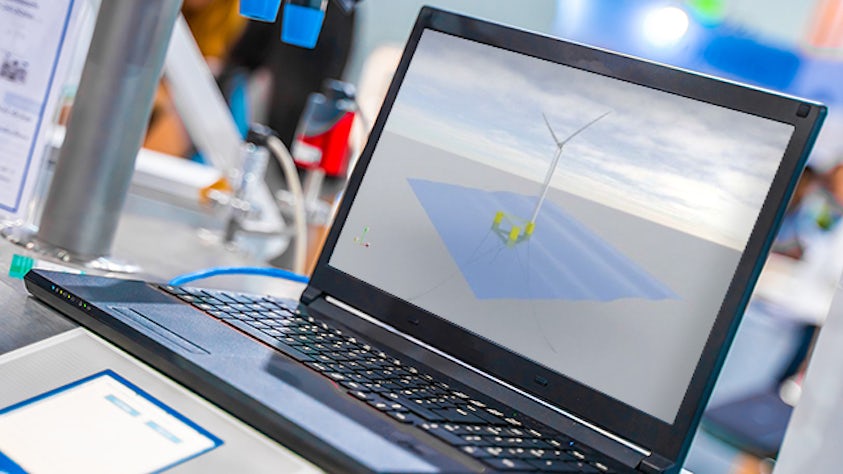
Managing periodic and transient loading
Safety of offshore wind turbines is essential to achieving certification to get them into operation, but physical testing during the development process is time-consuming and costly. This is why Front Energies uses simulation to analyze designs and streamline development.
Jang Kim, chief executive officer (CEO) of Front Energies, explains the main challenge with floating offshore wind turbine platforms is they experience periodic loading from the rotating turbine and transient loading from the waves.
“The aeroelastic turbine behavior and the floating platform’s exposure to irregular waves lead to intrinsically nonlinear loads acting onto the structures,” he says. “Therefore, time domain structural assessment is required by international regulations to ensure safe design and operation.”
When Front Energies began working in this area, they found the existing tools in the market would take too long to get the results they needed. Instead, they created a new solution that would perform the calculations much faster.
-640x360.jpg?auto=format,compress&w=843&q=60)
Improved structural time domain analysis
Front Energies developed TRUe Structural Time domain analysis (TRUST©) to carry out the necessary analysis of floating platform designs. It uses the Lodal Analysis Method, which expresses load responses in terms of spectral components before applying Inverse Fourier Transformation. This method helps to minimize the required finite element analysis (FEA) simulation effort. The method has proven to be more than 100 times faster than traditional time-domain analysis and uses more than 10,000 times less data storage.
TRUST is based on a combination of tools including Simcenter Nastran and Simcenter STAR-CCM+. “Simcenter STAR-CCM+ is the best CFD software we’ve found,” says Kim. “It has great scalability in terms of speed and its flexibility allows us to easily couple it with our in-house tools. When we were using different software solutions separately, it would take several days to set up a coupled simulation of a floating wind platform. Now, with Simcenter, it takes a matter of hours.
“The main benefit of introducing Simcenter STAR-CCM+ is in reducing the time and cost of prototyping. This was normally done at least a year into a project due to the expense, so if it highlighted major design issues it was a big problem to go back and make changes. Now we can carry out virtual model tests much earlier in the development phase to help with design decisions.”
Crucially, Front Energies has been able to prove the effectiveness of TRUST. “Our customers have been really impressed with how accurate our simulations are compared to physical testing,” says Kim. “We’ve shown them we can predict exactly how the platform will behave in the real world, which makes their designs more accurate and efficient.”
-640x360.jpg?auto=format,compress&w=843&q=60)
Expanded analysis
Having perfected the design and analysis of the floating platform, Front Energies is now turning its attention to the rest of the structure. “We’re extending our modeling to the turbine tower as a next step,” says Kim. “We’re also hoping to extend our modeling to the turbine blade so that we can analyze the complete structure.”
When we were using different software solutions separately, it would take several days to set up a coupled simulation of a floating wind platform. Now, with Simcenter, it takes a matter of hours.