Leveraging simulation to overcome the thermal and environmental challenges of the Moon
Astrolab uses Siemens Xcelerator to cut iteration time by 50 percent and win NASA contract to advance LTV

Astrolab
Astrolab is pioneering new ways to explore and operate on distant planetary bodies. The company is focused on designing, building and operating a fleet of multipurpose commercial planetary rovers to extend and enhance humanity’s presence in the solar system.
- 本社:
- Hawthorne, California, United States
- 製品:
- Simcenter 3D software
- 業種:
- 航空宇宙 / 防衛
Simcenter 3D Space Systems Thermal is a real game-changer for a small business like Astrolab and enables us to compete with much larger engineering companies.
Putting wheels back on the Moon
Later this decade as part of the Artemis campaign, NASA will land astronauts on the Moon for the first time since the 1970s. Unlike the Apollo missions, many of the Artemis campaign elements will be subcontracted to private companies.
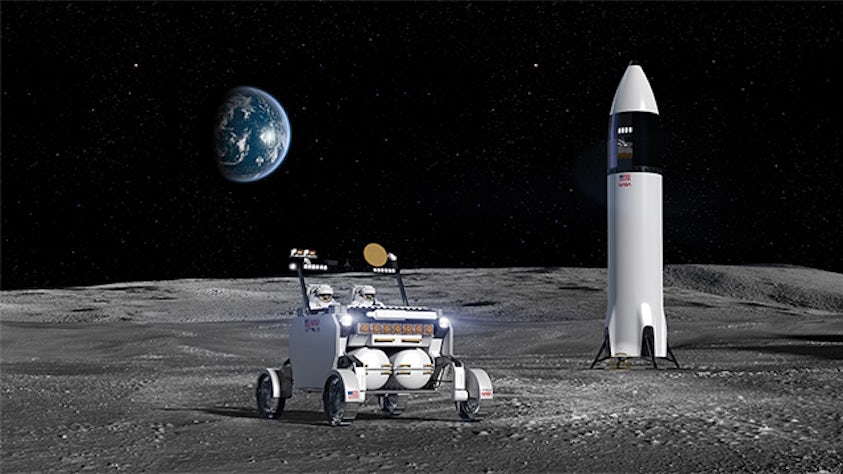
One such element is NASA’s Lunar Terrain Vehicle (LTV) that will be used to transport astronauts across the surface of the Moon. Based on its proposal, Astrolab was one of three businesses that was awarded a one-year contract to advance the development of NASA’s LTV.
Just getting to this stage was a significant achievement, as the team had to show that its Flexible Logistics and Exploration (FLEX) Rover could survive the harsh environment of the Moon and keep astronauts safe during operation. Additionally, while most of the competitors have thousands of staff and extensive resources to call on, Astrolab is a small business of just 35 people, making the awarding of the contract even more impressive.
To prove the viability of the concept, Astrolab built simulations using Simcenter™ 3D Space Systems Thermal software. The team also used NX™ CAD software for design and Teamcenter® software for product lifecycle management (PLM). These tools are part of the Siemens Xcelerator business platform of software, hardware and services.
Coping with the harshest environment
Designing a vehicle to drive on the Moon presents many challenges, but as Rius Billing, chief engineer at Astrolab explains, one of the biggest is coping with the thermal conditions. “In some ways, the Moon is more challenging than Mars,” Billing says. “The Moon is much closer, but unlike Mars, it has no atmosphere. This vacuum means you must deal with the extremes of cold and heat depending on where you are. You may even have one side of your vehicle in the shade and the other in the sun at the same time, so thermal design is incredibly complex.
“Our mission is at the lunar South Pole, which won’t be as hot as the equator, but it still reaches 54 Celsius during periods of sunlight. Conversely, the permanently shadowed regions the vehicle is designed to explore can fall as low as -240 Celsius.”
Further, since moon dust is extremely abrasive – Billing describes it as “like tiny glass shards that scratch and wear out anything that moves” – the team also had to ensure the thermal surfaces could withstand this environment and maintain performance. It’s a tricky balancing act to build a vehicle that is powerful enough to drive at up to 15 kilometers per hour carrying astronauts and equipment as well as coping with the thermal and environmental challenges.
-640x360.jpg?auto=format,compress&w=843&q=60)
Flexibility, safety and reliability
It was named the FLEX Rover because it was designed to excel in different roles. With a modular payload capability, it can be configured in a multitude of ways to accommodate astronauts and support a range of payload sizes. FLEX is designed to operate autonomously so it can be used for commercial and NASA projects outside the six and one-half days every two years that astronauts will be on the Moon.
Paul Lees, senior mission integration engineer at Astrolab, explains that proving its suitability for NASA added extra complexity to the project. “We had to show that FLEX can carry a crew up to 10 kilometers from the safe zone and be sure to get them back,” he says. “Because human life is at risk, this requires extra redundancy, more stringent testing and greater battery capacity.”
NASA also requested a vehicle that can last for several years, adding more development challenges as lithium-ion batteries will degrade due to age, cycling and non-optimal temperatures. China has a rover on the far side of the moon powered by nuclear isotypes, but NASA rejected this due to the potential radiation risk to crew and future inhabitants of a planned Moon base.
“Our vehicle needs to survive solely on battery storage for periods when the sun is down,” says Lees. “We must keep all the components at allowable temperatures for around five days in darkness, so it’s crucial we correctly analyze the power budget. When the astronauts are using the rover, it gets worked much harder with different duty cycles and additional thermal control requirements. This makes the design more complicated as you need to save heat while hibernating during the lunar night and reject the heat of energy-intensive crewed operations during the day.”
-640x360.jpg?auto=format,compress&w=843&q=60)
Thermal simulation
Using Simcenter 3D Space Systems Thermal was vital to proving Astrolab’s concept, and Lees says it wouldn’t have been possible without the expert help of Siemens Digital Industries Software partner Maya HTT. “Maya HTT provided us with an environmental model of the Moon that gave us a head start,” he says. “This meant we could jump straight into design modeling that saved us a lot of time. We could immediately start modeling objects on the lunar surface that we then validated against a large amount of data.”
FLEX Rover generates a kilowatt (kW) of heat during operation that must be safely radiated away but also must be thermally controlled during periods of darkness to not lose too much heat. Then it must be ready to come out of hibernation when the Sun comes up. Lees and his team built a representation of the FLEX vehicle in Simcenter 3D Space Systems Thermal, which provides a comprehensive set of tools to perform orbital and ground thermal analyses of spacecraft and is used to analyze the vehicle in enveloping thermal environments.
“We used Simcenter 3D Space Systems Thermal to simulate how much energy FLEX consumes at different temperatures and in different configurations, as well as experimenting with multiple durations of hibernation,” he says. “This enabled us to calculate exactly how much energy is needed to stay in darkness for 150 hours and informed decisions on sizing components and batteries.”
Due to playing multiple roles, FLEX was designed in an unconventional shape compared to the rover for the Apollo missions. It has a bigger surface area that changes depending on the size of the payload being carried, which can be up to one and one and one-half times its mass. A greater surface area means increased heat loss and radiation, so the multilayered insulation had to be carefully sized for optimum protection and minimal weight. After starting with a basic insulated shape, Astrolab added components such as wheels, wheel actuators, solar panels and radiators to get a complete understanding of how it would perform during operation and hibernation in the harsh Moon environment.
Astrolab used this model to show NASA simulations of the rover going through a lunar night and waking up from hibernation.
-640x360.jpg?auto=format,compress&w=843&q=60)
Designing with NX and scaling with Teamcenter
It was crucial to minimize the weight of FLEX as much as possible. The heavier it is, the more it costs to get it to the Moon, and the less mass is available for commercial payloads. Astrolab used NX as the core computer-aided engineering (CAD) tool along with Simcenter Nastran for finite element analysis (FEA) to design the core chassis, size components and optimize the mass.
Billing says they also used Simcenter 3D Motion for kinematic studies and Simcenter Nastran and Simcenter Femap for analysis of dynamics and stress. “Being able to integrate these tools seamlessly was a great advantage,” he says. “It allowed us to quickly reiterate on the CAD model and automatically feed it into Simcenter rather than manually transferring data. Without this, each iteration would have taken twice as long.”
As the team grew, Astrolab adopted Teamcenter to manage designs and allow multiple engineers to easily collaborate on the assembly. “Teamcenter is the first PLM I’ve used that doesn’t get in your way,” says Billing. “We abandoned others because checkouts and check-ins took far too long and slowed us down. Teamcenter is seamless and I’m happy with how it works for us.”
Democratizing space exploration
“Maya HTT has played a crucial role in getting Teamcenter set up on the Azure cloud,” says Billing. “They’re always on hand for support and help with licenses, and now they’re helping us build a custom workflow to further streamline our processes.”
Lees is certain that the FLEX Rover project wouldn’t have been viable without Siemens’ integrated solutions. "Without an off-the-shelf tool like Simcenter 3D Space Systems Thermal, we wouldn’t have been able to validate our concept,” he says. “Simcenter 3D Space Systems Thermal is a real game-changer for a small business like Astrolab and enables us to compete with much larger engineering companies.”
NASA will make its final decision on which LTV will form part of the Artemis mission in 2028. They may even choose more than one, but even if FLEX isn’t selected, it will still go to the Moon on a commercial mission. “We have a separate commercial contract running on a parallel timeline,” says Lees. “Our design allows us to adapt the commercial vehicle to include all the extras needed to make it suitable for astronauts.”
Clearly, the future of space exploration will rely on collaboration between government and private manufacturers. Thanks to the integrated, affordable solutions of Siemens Xcelerator, even the smallest companies will have the opportunity to play a role in taking humanity to the stars.
Being able to integrate these tools seamlessly was a great advantage. It allowed us to quickly reiterate on the CAD model and automatically feed it into Simcenter rather than manually transferring data. Without this, each iteration would have taken twice as long.