Using the digital twin to reduce manual efforts and delay risks while increasing transparency across the shop floor
Sim.Tec. uses Plant Simulation to improve Siemens customers’ operations and processes

Sim.Tec.
Sim.Tec. S.r.l is an engineering consultancy that supports companies in analyzing logistics, production and organizational flows. Their core business is to optimize these flows.
https://www.simtec-group.eu/en/
- Siège social:
- Collegno, Italy
- Produits:
- Opcenter APS, Plant Simulation X Essentials
- Domaine d'activité:
- Aéronautique et Défense, Automobile et Transports, Machines industrielles, Équipements lourds
Our goal is to make the digital twin accessible, especially for smaller manufacturers who think it might be out of reach.
Partnering to achieve the best of both worlds
A digital twin links real-world production with its virtual model, unlocking significant potential. For mid-sized manufacturers, the focus is not only on technology, but on the benefits it brings to daily operations, including clearer visibility, more precise planning and greater certainty in execution. A digital twin maps what is physically happening in the plant and shows what the company could achieve, without interfering with ongoing operations. The results are robust enough to support sound business decisions.
Additionally, mid-sized manufacturing companies operate under constant pressure. Markets shift quickly, supply chains are sensitive and customers expect short lead times and dependable delivery. To stay competitive, businesses need adaptable structures and processes that remain manageable as operations grow more complex.
To help with this, it is beneficial to have a partner who understands these needs and how mid-size manufacturers can get the most out of their digital solutions. Sim.Tec. S.r.l., based in Collegno, Italy, is a Siemens Digital Industries Software partner aiming to help by delivering projects built using the Tecnomatix® portfolio and Plant Simulation in the Tecnomatix portfolio, which are part of the Siemens Xcelerator business platform of software, hardware and services.
-640x360.jpg?auto=format,compress&w=843&q=60)
Transforming digitally using a measured approach
Digital transformation can make processes easier to understand and decisions more reliable. For many mid-sized manufacturers, the question is less about value and more about practical feasibility. Production processes are the backbone of any operation; thus, companies need to approach changes carefully, without interrupting ongoing work while keeping within a budget.
When selecting a solution, it is tempting to focus on features alone; however, the long-term fit also matters since the software must suit the business and remain in place for years. This is where Siemens has a clear advantage as it continues to develop and support its technology long term.
Leveraging the Siemens Industrial Metaverse ensures systems can communicate seamlessly while remaining accessible and allowing users to map processes across various platforms. Equally important is the partner who implements the solution. Experience, continuity and a realistic understanding of operations determine whether a project works in practice. With a solid foundation in place, operations run smoothly, which is where Sim.Tec. comes in.
Leveraging an experienced partner for realistic simulation
For decades, Sim.Tec. has helped companies analyze their operations and improve them using targeted simulations and the digital twin. Tecnomatix simulation tools form the foundation of this work.
The focus is always on physical operating conditions. Sim.Tec. reviews existing processes, develops specific alternatives and evaluates their impact on key performance indicators (KPIs) such as lifecycle cost (LCC), overall equipment effectiveness (OEE) and service rate. This produces a clear and reliable picture of where improvements are possible.
Whether the goal is planning, expanding or reorganizing, Sim.Tec. provides decision-makers with a solid basis for securing investments and preparing operations for the future.
Shifting to a solid optimization scenario
Every Sim.Tec. project begins with a detailed analysis of the customer’s current production system. This covers real-world processes, existing layouts, material flows and capacity limits. Based on this, Sim.Tec helps the customer create a digital model via Plant Simulation, which fully reflects the company’s current state and can be used to test a range of scenarios.
Collaborating closely with the customer, Sim.Tec. develops what-if scenarios, including optimized workflows, alternative layouts and technical specifications for potential implementation. Simulation makes it possible to compare these options objectively using agreed upon KPIs.
Using Plant Simulation makes technical possibilities visible and measurable. The results give management a dependable foundation for investment decisions and capacity planning.
Making digital models easy to use
A digital twin delivers full value when connected reliably to live company data, which companies can achieve by leveraging a broad set of interfaces within Plant Simulation. Companies can import data from enterprise resource planning (ERP) systems, manufacturing execution system (MES) platforms or spreadsheets automatically. For example, via structured query language (SQL) databases or JavaScript object notation (JSON) files. Direct access to machine or control data is also possible using OPC Unified Architecture (UA) or Siemens’ PLCSim Advanced, a tool for simulating programmable logic controllers (PLC).
Sim.Tec. uses these capabilities to integrate digital models into the customer’s existing information technology (IT) landscape. In planning environments, with the support of the Siemens partner, ATS Team3D, Sim.Tec. uses Opcenter™ Advanced Planning and Scheduling (APS) software, which is also part of the Siemens Xcelerator business platform, to provide order and scheduling data. In intralogistics, they can also connect SIMOVE, the Siemens platform for automated guided vehicles, as well. These integrations turn
the digital twin into a working element for daily operations.
The result is an environment that supplies users with real-time data and provides actionable decision support. Technical effort stays manageable by relying on established protocols and proven Siemens components.
Overcoming complex processes via daily scheduling
One Sim.Tec. customer, MEC S.r.l., which manufactures electronic assemblies in medium volumes, needed help assigning and scheduling new, daily orders. The goal of this project was to bring structure to this process and create a tool that employees without a simulation background could use confidently in their day-to-day work.
Sim.Tec. built a model using Plant Simulation directly connected to MEC’s production database. After authenticating the use, the system automatically imports the current production orders, ensuring data is accurate and up to date.
The simulation processes this information and produces a daily schedule that covers machine use, shift assignments and the number of pallets each product line needs. Output includes the planned completion time, an analysis of pallet requirements and the allocation of stations and workers. The system exports these results as a text file, making them easy to share or process further.
For visualization, planners can work directly in the simulation model or use SimGANTT, an HTML5-based application Sim.Tec. developed. It generates Gantt charts for machines and staff assignments, providing an at-a-glance view of the entire day’s schedule. Sim.Tec designed the interface so nonspecialists can interpret it without additional training, allowing daily use outside the simulation team.
By combining automated data import with clear visual output, MEC gained a reliable, repeatable process for daily scheduling. The company reduced manual effort, improved coordination between workstations and increased transparency across the shop floor.
Achieving reliable delivery dates via automated planning
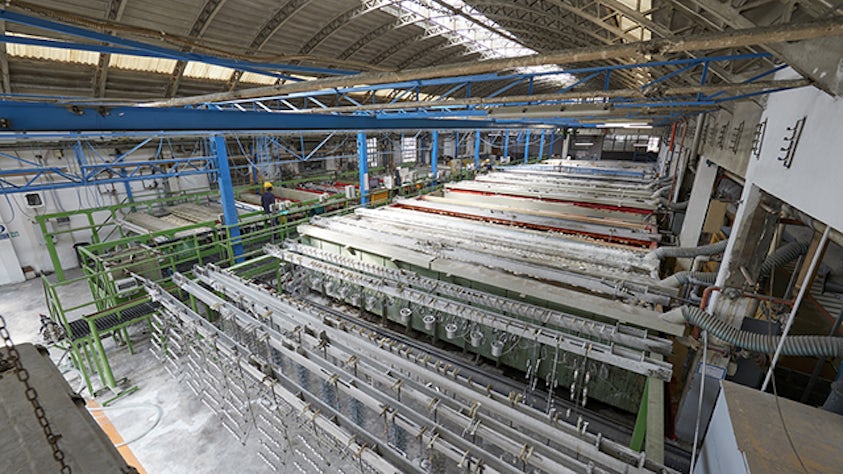
Another Sim.Tec. customer, the GASER Group, operates several surface finishing plants and needed a way to generate realistic delivery dates directly from the current order situation without any manual handling between systems. The company needed the solution to work seamlessly with its existing ERP and MES platforms and deliver results that the production and sales teams could trust.
Sim.Tec. developed a model using Plant Simulation that fully integrated into GASER’s IT landscape via an application programming interface (API). After secure authentication using a token-based login, the system automatically retrieves the latest order list from the customer’s internal systems. Each record contains the order’s identification number, receipt date, requested delivery date and quantity.
After importing the data, the simulation processes the order data and generates a realistic production schedule that accounts for the plant’s capacity, sequencing and physical constraints. The system then sends back the calculated delivery to the ERP system via the same API structure. This bidirectional data flow eliminates the need for manual updates, reducing the risk of delays or errors.
Sim.Tec. designed the model for daily use, even by staff without simulation expertise. Planning and sales teams can access the calculated delivery dates directly, ensuring everyone works from the same reliable data. For sales, this means greater confidence when committing to customers. For production, it provides a stable planning baseline that is updated automatically as new orders come in.
With this integration, GASER gained a planning process that is faster, more transparent and less dependent on manual intervention, which strengthened internal coordination and customer communication. Using the digital twin has also reduced the time required for technical and economic evaluations of new orders by about 30 percent compared to the previous manual approach.
“Thanks to Sim.Tec. and the digital twin, we have turned a manual and subjective process into a structured and repeatable system,” says Stefano Nicolini, plant manager at GASER. “The simulations are now more reliable, and we’ve reduced the analysis time significantly. Today, we can respond to customers faster, with greater precision and a clearer strategic perspective. “
Helping mid-sized businesses leverage simulation as a tool
The MEC and GASER examples show that even long-established, mid-sized operations can achieve measurable improvements by leveraging a digital twin model that accurately captures real-world processes and forms a sound basis for informed decisions. Tools like Plant Simulation are beneficial due to integrating smoothly with existing systems and daily workflows.
Simulation does not replace experience; it helps companies apply it more effectively. Confident planning needs a solid foundation; however, Sim.Tec.’s goal is not to rebuild everything, but to focus precisely on what they can help their customers improve.
“Our goal is to make the digital twin accessible, especially for smaller manufacturers who think it might be out of reach,” says Patrizia Bucci, owner and chief executive officer (CEO) at Sim.Tec. “It’s not. It’s ready to be used where it matters.”
Thanks to Sim.Tec. and the digital twin, we have turned a manual and subjective process into a structured and repeatable system. The simulations are now more reliable, and we’ve reduced the analysis time significantly. Today, we can respond to customers faster, with greater precision and a clearer strategic perspective.