Assessing biocide consumption patterns and identifying untreated pipes for maintenance using an executable digital twin
BASF uses Simcenter Flomaster and an executable digital twin to provide insight into pressurized utility grid conditions

BASF Antwerp
BASF is one of the largest chemical producers in the world, providing chemicals and materials for industries ranging from agriculture, automotive and construction to electronics, energy and utilities. The BASF site in Antwerp is their second-largest chemical production site, with over 50 production facilities.
- Sídlo:
- Antwerp, Belgium
- Produkty:
- Simcenter Flomaster software
Without the Simcenter Executable Digital Twin, if we had issues, we could only analyze the consequences and not the cause. But using it provides us with real-time analysis.
Producing a wide range of chemicals and materials globally
BASF is one of the largest chemical producers in the world, providing chemicals and materials for industries spanning from agriculture, automotive and construction to electronics, energy and utilities. The BASF site in Antwerp (BASF Antwerp) is their second-largest chemical production site. With over 50 production facilities on site, their product range includes basic and specialty chemicals, plastics, precursors and inorganics.
-640x360.jpg?auto=format,compress&w=843&q=60)
Overcoming maintenance challenges in site-wide utilities
BASF Antwerp’s utilities division was facing a problem. Over time, the company made multiple extensions to the pressurized brackish water and steam grids, resulting in difficulties obtaining accurate and actionable information.
With more than 50 plants on site using and producing utilities, the BASF utility grids are complex and difficult to manage. One of the most challenging grids is the brackish water grid, which is used as cooling water. There are several users and producers with varying loads where the utility plant needs to react properly. Anticipating these changes correctly ensures a more stable grid and, therefore, stable operations.
BASF Antwerp adds biocides to the pipes to prevent marine life from growing inside the pipes, filters and heat exchangers. This biocide has adverse environmental implications. To decrease this adverse impact, it must reach all pipe sections throughout the network in sufficient quantity to eliminate the growth of marine life and be completely consumed before the water is discharged into the environment. Locating untreated or partly blocked pipes is time-consuming because the grids are maze-like, with varying pipe sizes, and are complex to understand without calculations. Additionally, grid upsets become hard to analyze and root causes cannot always be found.
Adding more instrumentation was not pragmatic or cost-effective. First, BASF grids are all over the site, over pipe racks and underground. The utility plant’s distributed control system (DCS) is often situated too far away to make a connection. Second, wireless sensors on isolated pipes in pipe racks are not easy to install or maintain. Finally, the cost for installing and integrating sensors while accessing underground pipes, is highly prohibitive.
Solving these problems required an intelligent and nondisruptive method to manage their complex water-cooling and steam networks across multiple facilities. This led BASF to leverage Siemens Digital Industries Software’s Simcenter™ Flomaster™ and the Simcenter Executable Digital Twin solution, which are part of the Siemens Xcelerator business platform of software, hardware and services.
-640x360.jpg?auto=format,compress&w=843&q=60)
Automating the physics-informed operations loop
Although BASF Antwerp tasked the engineering and research and development (R&D) teams with modeling the safest and most efficient sizing for pipes and junctions, the operations team was responsible for all aspects of day-to-day production. Since these teams have different goals and focuses, they do not usually work together when it comes to daily business. Therefore, the company never thought about using Simcenter Flomaster for operations. However, as the plant focused more on digital tools and thinking outside of the box, BASF Antwerp realized it could be beneficial for operations. Although the deliverables of each team were different, there would be significant value for the overall business by connecting the expertise of the two teams, especially if the method was robustly automated to close the loop between engineering and operations.
The goal was to automate exchanging real-time operational variables from the plant, update the model with this operational information to the as operated state and extract the calculated information to feed into real-time systems. This automation would enhance efficiency and accuracy.
-640x360.jpg?auto=format,compress&w=843&q=60)
Implementing simulation models as an executable digital twin
Using Simcenter Flomaster, the engineering teams created and used a thermohydraulic model for the existing plant cooling system. When configured with up-to-date boundary conditions from sensors and run alongside the real plant, this model is fast enough to provide operators with timely, actionable insights.
To leverage the system models in real time, BASF Antwerp deployed them as an executable digital twin, fed by a live internet of things (IoT) data stream from the physical plant and hosted in BASF’s on-premises cloud.
An executable digital twin has a simulation and/or test-based model at its core, which is packaged in a standalone format. It contains a physics-based behavioral model that is connected to the physical system, providing deeper insights into plant operations. These standalone formats can be further integrated into edge devices for critical insights into asset conditions, augmenting the overall asset management framework.
The physical plant’s live models combine data from the physical and digital (simulation) worlds, providing operators with deep insights into flow conditions across the plant. With the executable digital twin in place, BASF Antwerp can monitor the behavior of complex processes, predict how changes would affect them and optimize operations accordingly.
“Without the Simcenter Executable Digital Twin, if we had issues, we could only analyze the consequences and not the cause,” says Peter Verheyden, assistant process manager at BASF Antwerp. “But using it provides us with real-time analysis.”
-640x360.jpg?auto=format,compress&w=843&q=60)
Managing automation complexity with Orise
There were several layers of challenges in automating the system, which were handled by Orise (formerly known as Process Automation Solutions), a leading process consulting agency for industrial operations. While working on automation, Orise also developed expertise using Simcenter for modeling and simulation and created the biocide dosing calculations as well as the steam system network.
Orise tackled critical challenges such as linking to data, setting up the necessary data infrastructure and establishing cybersecurity protocols to control access. They also focused on determining the model’s update frequency, implementing checks and balances to ensure accuracy and planning for potential failure scenarios. Additionally, they addressed redundancy checks to manage multiple data points.
To reduce training overhead and unnecessary investment in advanced knowledge, they designed the automation system to be more operationally oriented. Rather than using complex software, the system needed to function in an environment that constantly updates with real-time data and offers a user-friendly interface.
Gaining real-time insights
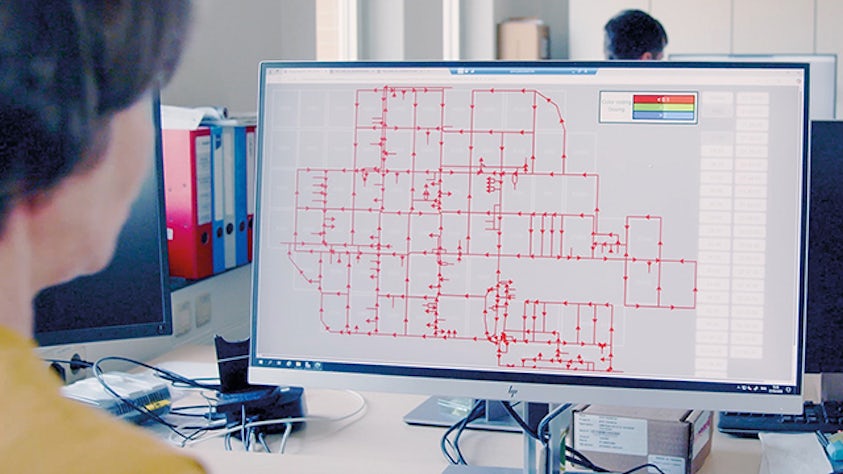
Following the successful implementation of the executable digital twin, the operations team realized significant benefits. Using an executable digital twin led to a clear understanding of flow distribution, especially flow velocities, allowing BASF Antwerp to assess the impact of changes in consumption patterns and maintenance on other plant sections. This knowledge is crucial for managing flow velocities, as increased flows lead to pipe erosion.
“With the calculations from the Simcenter Executable Digital Twin solution, we can predict flow, temperature and pressure conditions, analyze the current situation and optimize long-term operations accordingly,” says Catherine Steukers, project operations manager of the energy plant at BASF Antwerp.
Previously, the process management team had to trace biocides (like chlorine) to detect blockages caused by marine life buildup. With the new system, they could easily correlate flow data with model predictions and monitor flow distribution to evaluate the effectiveness and residence times of their chemical injections. This capability greatly enhanced their trouble-shooting efforts and system assessments.
“By using the Simcenter Executable Digital Twin solution, we have an end view of how our network runs to avoid still-standing sections in our grids and having biological growth in our brackish water network,” says Kurt Yserbyt, senior lead of process engineering at BASF Antwerp.
Leveraging physics-informed digitalization
Digitalization is far more than instrumenting and installing sensors and a supervisory control and data acquisition (SCADA) system. Thus, BASF Antwerp decided to adopt physics-based modeling as a key component of their digitalization efforts due to two primary drivers: the need to challenge the status quo and the desire to improve their competitive position.
“It helped that no new hardware such as flow meters, pressure transducers or sensors were required to implement the automation,” says Steukers. “The BASF operators could quickly pick up the functionalities of Simcenter Flomaster and the Simcenter Executable Digital Twin.”
This means the virtual sensors, which are a key part of the executable digital twin, are not only providing insights, but also save money.
Achieving a bigger business impact with the same effort
The developed model’s value far exceeded the initial needs of the engineering and operations teams at BASF Antwerp. The initial implementation focused on the water-cooling network and expanded to the steam system. BASF Antwerp aims to expand it further to include additional models of two new cooling towers that are set to become operational. For this, they will use Simcenter Flomaster to develop custom models.
“As we have had positive results with using Simcenter Flomaster, we would like to extend the executable digital twin to other pressurized grids across our site,” says Steukers.
This transition involves placing the model in an automated loop to enhance its accessibility and use. This will enable BASF to multiply its impact and generate more return-on-investment (ROI) from the same efforts as the initial implementation.
As we have had positive results with using Simcenter Flomaster, we would like to extend the Executable Digital Twin to other pressurized grids across our site.